Dissertation Review of Dr. Sefriani on the Enforcement of International Commercial Arbitration Awards

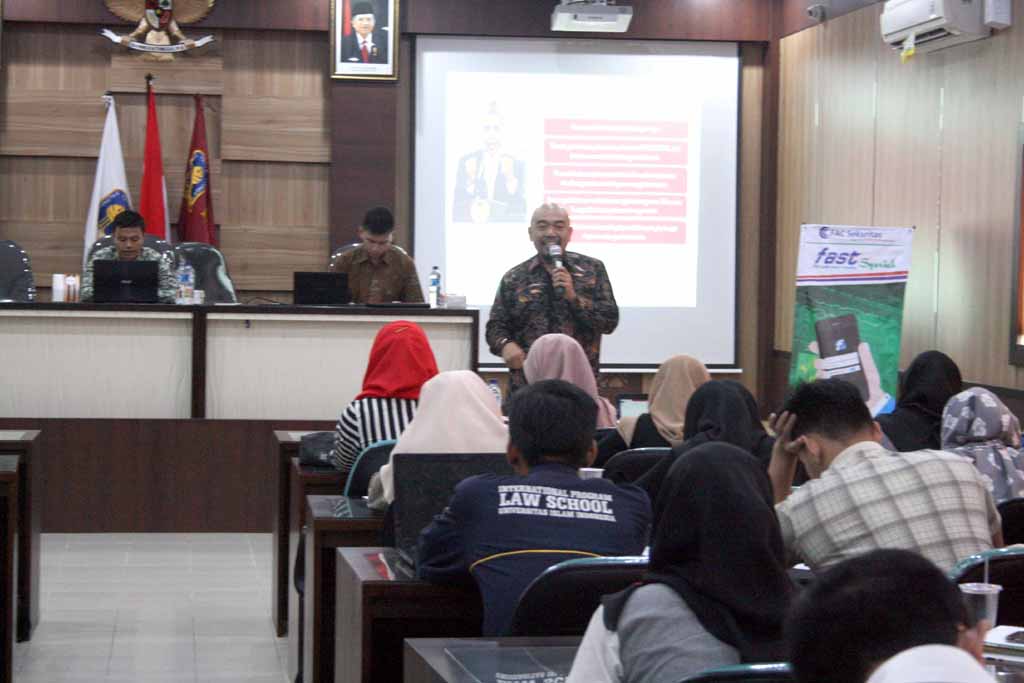
Monday, May 27, 2013 at Main Meeting Room of the UII Faculty of Law Jln. Tamansiswa 158 Yogyakarta was held a Dissertation Review entitled Implementation of International Commercial Arbitration Decisions related to State Asset Immunity with the speaker and author of the Dissertation, namely Dr. Sefriani, SH., M.Hum. Attended by approximately 150 participants, the event was opened at exactly 09.00 WIB by the Deputy Dean of the UII Faculty of Law Saifudin, SH., M.Hum., Ph.D. Moderated by one of the young lecturers of the UII Faculty of Law Dodik Setiawan, SH., MH, the discussion went smoothly until nearing Dhuhur.
Main Meeting Room of the UII Faculty of Law Jln. Tamansiswa 158 Yogyakarta was held a Dissertation Review entitled Implementation of International Commercial Arbitration Decisions related to State Asset Immunity with the speaker and author of the Dissertation, namely Dr. Sefriani, SH., M.Hum. Attended by approximately 150 participants, the event was opened at exactly 09.00 WIB by the Deputy Dean of the UII Faculty of Law Saifudin, SH., M.Hum., Ph.D. Moderated by one of the young lecturers of the UII Faculty of Law Dodik Setiawan, SH., MH, the discussion went smoothly until nearing Dhuhur.Monday, May 27, 2013, at the Main Meeting Room of the UII Faculty of Law, Jln. Tamansiswa 158 Yogyakarta, a Dissertation Review entitled Implementation of International Commercial Arbitration Decisions Regarding State Asset Immunity was held with the speaker and author of the Dissertation, namely Dr. Sefriani, SH., M.Hum. Attended by approximately 150 participants, the event was opened at exactly 09.00 WIB by the Vice Dean of the UII Faculty of Law, Saifudin, SH., M.Hum., Ph.D. Moderated by one of the young lecturers of the UII Faculty of Law, Dodik Setiawan, SH., MH, the discussion ran smoothly until nearing Dhuhur.
Dr. Sefriani completed her doctoral studies in a remarkably short time, taking just 2 years and 3 months. She completed the doctoral program at Gadjah Mada University (UGM) with the shortest study period, and no one has surpassed her, even with the highest grades. "Alhamdulillah, it's all by the will of Allah SWT alone." "I'm just going through the motions and trying my best," she humbly affirmed to the audience as the moderator introduced the profiles of the dissertation speakers.
The speaker stated that the main problem in this research is:
- How do countries practice enforcing international commercial arbitration awards when dealing with the immunity of foreign assets and what differences arise in the practices of these countries?
- What factors cause differences in the practices of countries when implementing international commercial arbitration awards regarding the immunity of foreign state assets?
- How to balance two different interests, the interest in maintaining the immunity of foreign state assets on the one hand and the interest in implementing international commercial arbitration decisions on the other hand.
Meanwhile, the objectives of this research are three main points, namely:
- To understand and analyze how countries practice implementing international commercial arbitration decisions when dealing with the immunity of foreign state assets and to understand and analyze the differences that arise in the practices of these countries.
- To understand and analyze the factors that cause differences in the practices of countries in implementing international commercial arbitration decisions when dealing with enforcement immunity.
- To analyze and examine how to balance the interests of maintaining the immunity of foreign state assets on the one hand with the interests of implementing international commercial arbitration decisions on the other hand.
And with the methods that have been formulated and tested, the following conclusions can be obtained:
- Similarities and differences were found in the practices of the countries. The similarity is that all countries separate between jurisdictional immunity with enforcement immunity and has the AKI Law. The difference is that some countries apply limited immunity, while others apply absolute immunity. For jurisdictional immunity, most countries tend to apply limited immunity, while for enforcement immunity There is still a tendency towards absolute immunity. Seizing or executing foreign assets remains challenging, even with a binding AKI decision. The implementation of AKI decisions is subject to regulations on public order, procedural law, and the law of the courts. non-arbitrability and state immunity laws at the domestic level vary widely.
- The factors causing the differences are legal, ideological, psychological, sociological, and interest factors. All of these factors mutually influence the behavior of states, both the asset-owning state and the state where the assets are located, in enforcing AKI decisions by exploiting the existence of the foreign state asset immunity doctrine. Excessive use of the state immunity doctrine by both the asset-owning state and the state where the assets are located can undermine the objectives of the 1958 New York Convention and the 1965 ICSID Convention. On the other hand, the implementation of AKI decisions without considering the type of assets seized can disrupt the asset-owning state's ability to exercise its sovereignty in the state where the assets are located and can also threaten good relations between the asset-owning state and the executing state.
- Applying the principle of proportionality is a method that can be used to strike a balance between the interests of maintaining and utilizing the immunity of foreign assets and the interests of enforcing AKI decisions. This proportionality principle is realized by granting enforcement immunity to foreign assets in a limited and selective manner. Maintaining a balance between the interests of maintaining the immunity of foreign assets and the interests of enforcing AKI decisions is crucial, given that both essentially aim to maintain good relations between countries, exercise sovereignty, and advance the economy, all of which ultimately benefit the strengthening of the sovereignty of all countries involved.
So, through his dissertation, he suggested several things, namely:
- There is a need to review the legal loopholes provided by the 1958 New York Convention and the 1965 Washington Convention regarding the use of the doctrine of foreign state immunity so that it is not misused by countries that are unwilling to voluntarily implement the obligations arising from the AKI decision.
- There needs to be uniformity (consistency) related to foreign state immunity laws
- Countries, including Indonesia, must be selective and restrictive in utilizing or implementing the doctrine of foreign state immunity.
- The private sector must be aware of the privileges the state possesses. As a precaution, the private sector can ask the state to create a clause. waiver of immunity well jurisdictional and enforcement immunity also asks the state to place earmarked property and insurance
- Sanctions for countries that do not want to implement AKI decisions voluntarily.