

 Faculty of Law Universitas Islam Indonesia
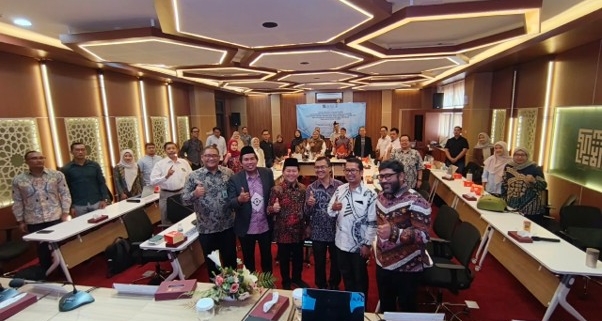
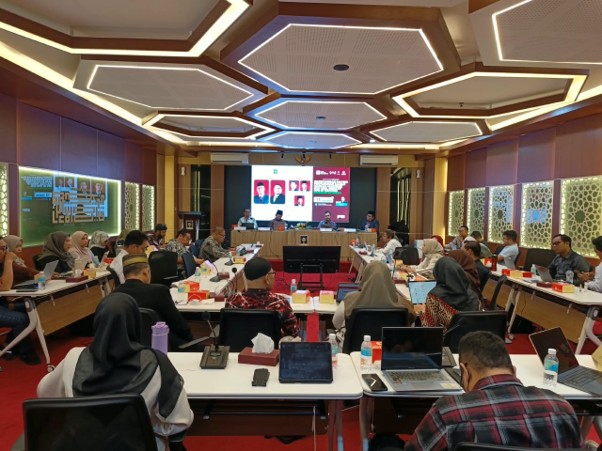
YOGYAKARTA - Faculty of Law Universitas Islam Indonesia (FH UII) in collaboration with the Secretariat General of the Regional Representative Council of the Republic of Indonesia (Setjen DPD RI) held Focus Group Discussions (FGD) Inventory of Materials for the Preparation of the Academic Paper Study of the DPD RI Initiative Draft Bill on Sharia Economics, Tuesday (10/13/2026), at the 4th Floor Mini Auditorium of the Faculty of Law, UII. This activity was part of a working visit by the DPD RI Secretariat General's Legislation Drafting and Monitoring Division to the Special Region of Yogyakarta.
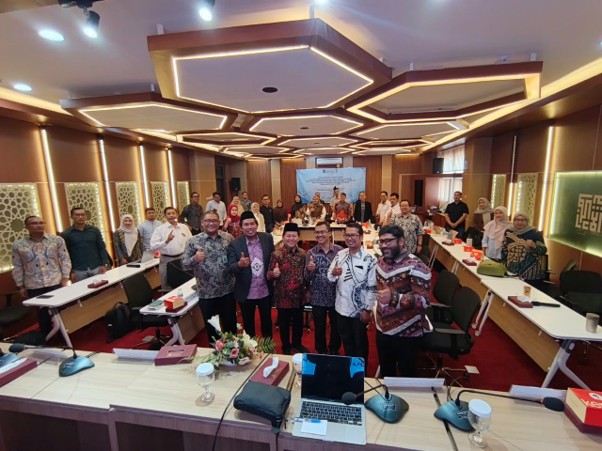
Group photo of the resource persons and FGD participants
The event began with remarks from the Dean of the Faculty of Law, University of Indonesia (UII), Drs. Agus Triyanta, MA, MH, Ph.D., who emphasized the importance of sharia economic law. He cited the example of more than 50 sharia hospitals and the rapid growth of sharia hotels, despite the lack of regulations. "Even though the government doesn't regulate them, the industry continues to operate. Rather than being devoid of regulations, the government should begin accelerating efforts to prevent the misuse of sharia symbols," he said. He also expressed his gratitude that issues previously discussed in the classroom are now being accommodated, listened to, and recorded.
Then, a speech was also given by a representative from the Secretariat General of the DPD RI, namely the Head of the Drafting and Monitoring of Legislation of the Secretariat General of the DPD RI, Eko Prasetyo Nugroho, SIP. In his speech, he explained that DIY was chosen as the inventory locus because its MSME ecosystem and halal tourism are well developed, plus the character of special autonomy that is rich in local wisdom. DIY is also a center of Muslim academic thought from leading universities, one of which is UII, and has productive practices in managing religious social funds. Therefore, the Secretariat General of the DPD RI also invited 2 (two) largest mass organizations, namely Nahdlatul Ulama and Muhammadiyah.
"We expect input from Muslim scholars in Yogyakarta to the drafting team to develop a comprehensive academic paper that meets the needs of the community," said Eko. He noted that current Islamic economic regulations remain sectoral and scattered, leading to overlapping authority, legal vacuums, and uncertainty for regional businesses. The FGD results will inform the drafting of the academic paper and draft bill, which is expected to become a proposed initiative by the Regional Representative Council (DPD) for submission to the government and the House of Representatives (DPR).
After that, we entered the main event, namely the Focus Group Discussion (FGD) moderated by Anang Zubaidy, SH, MH (Lecturer at the Faculty of Law, UII) with 3 (three) speakers. The first speaker, Dr. Nur Kholis, SEI, M.Sh.Ec. (Lecturer at the Faculty of Islamic Studies, UII), said that the nine existing laws were like nine entrances without a binding knot. He reminded that the bill should not add bureaucracy, not duplicate authority, and not lock numbers in the law. In his closing, he emphasized, "Don't wait for perfection because that will be very difficult and after perfection there will definitely be imperfections again. So this needs to be expedited.
The second speaker, Dr. Agus Miswanto, S.Ag., MA (Muhammadiyah Central Executive Board's Tarjih and Tajdid Council), observed that current regulations are still dominated by the financial sector. "The Halal Product Guarantee Law only regulates the product side; it doesn't regulate the ecosystem as a whole," he said. He proposed an omnibus law on sharia economics that would harmonize overlapping regulations, improve the compilation of sharia economic law from Supreme Court Regulations (Perma) into law, and strengthen the KNEKS (National Islamic Economics Council).
The third speaker, Bagya Agung Prabowo, SH, M.Hum., Ph.D. (Lecturer at the Faculty of Law, University of Indonesia (UII) and Head of the Undergraduate Business Law Study Program), outlined five parameters of urgency for the creation of legislation, ranging from real social needs to alignment with the constitution, using Malaysia as a comparison. "An umbrella law is absolutely necessary to provide clear direction, legal certainty, and accelerate the integration of the national sharia economic ecosystem," he concluded.
After the speakers presented their material, the event continued with responses from the attendees. One of the respondents from the National Committee for Sharia Economics and Finance (KNEKS), Dr. Dece Kurniadi, SH, MM, revealed that this bill has been included in the medium-term National Legislation Program (Prolegnas) in the House of Representatives (DPR) but has not yet become an annual priority. According to him, all provinces already have KDEKS and sharia economics is already included in the regional government information system. KNEKS targets discussions to begin in 2027, no later than before the RPJMN ends in 2029.
The discussion session and responses from the participants were lively. The Yogyakarta PWNU Economic Institute provided input for mass organizations to be involved as implementation partners. Then, UII Law Faculty lecturer, Dr. Abdul Jamil, questioned the use of the term "sharia" instead of "Islam" or "Islamic law." Several lecturers and doctoral students pushed for an omnibus format for this bill, clarity on the position of DSN-MUI fatwas, and the arrangement of dispute resolution institutions. Representatives of the DPD RI Secretariat General also asked the speakers about the choice of name and definition of the bill and how to avoid regulatory obesity. One of the speakers, Dr. Nur Kholis, stated that UII is ready to contribute to compiling the academic paper.
 Faculty of Law Universitas Islam Indonesia




