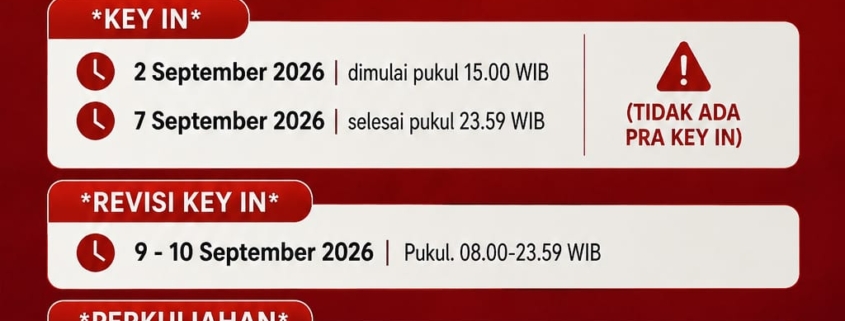
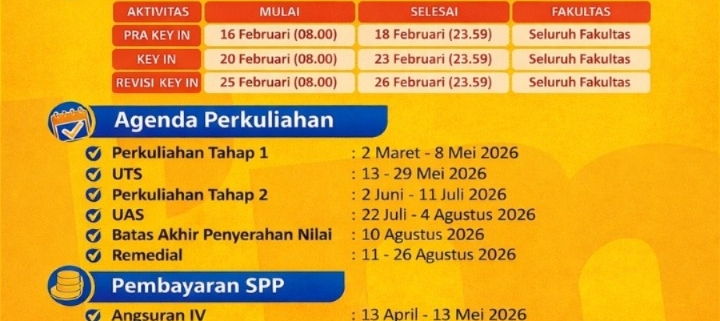
Contains academic information related to lectures, final exams, administration, and student activities within the learning process.


Announcement of Research Proposals Successfully Funded by the "Dean Research Grant 2026" Faculty of Law UII
Peace be upon you, and Allah's mercy and blessings
Bismillahirrahmanirrahim
After the process of evaluating the proposals sent by the participants was carried out, it was decided that the research proposals that were declared to have PASSED funding were as follows:
1. List of proposals Dean's Research Grant 2026 funded (S1-PSHPS) [Attachment]
2. List of proposals Dean's Research Grant 2026 funded (S1-PSHBPS) [Attachment]
3. List of proposals Dean's Research Grant 2026 funded (S2-PSHPM) [Attachment]
4. List of proposals Dean's Research Grant 2026 funded (S2-PSKPM) [Attachment]
5. List of proposals Dean's Research Grant 2026 funded (S3-PSHPD) [Attachment]
6. Research teams that are declared to have passed are required to attend briefings via Zoom Meeting on Tuesday, July 7, 2026 at 2:30 PM WIB via Zoom Meeting.
7. All information and research implementation activities will be carried out through Google Classroom.
We, as the committee, congratulate the research teams who have passed the research proposal selection process. We look forward to seeing those applicants who were not selected for the Dean's Research Grant next year.
Thus this announcement, we thank you for your attention.
Wassalamualaikum warahmatullahi wabarakatuh

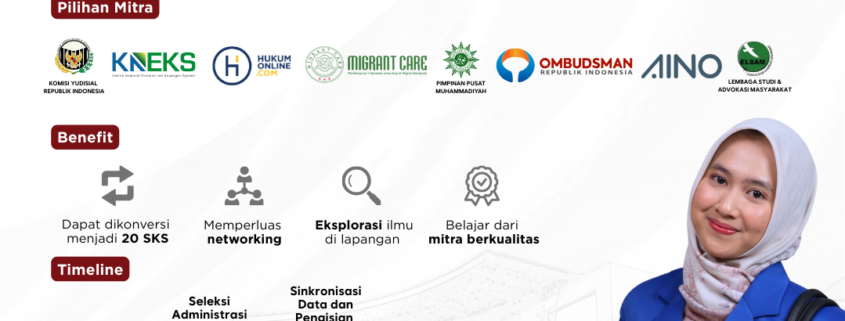
Bismillahirrahmanirrahim
We hereby submit the list of students who passed the administrative selection for the Legal Practice Impact Internship program for the Even Semester of the 2025/2026 Academic Year as follows ( attached ).
Participants who pass the administrative test are eligible to participate in the second stage of the test, namely the interview test, which will be held on Wednesday, February 18, 2026 , and Thursday, February 19, 2026, via Zoom meeting. Prospective participants who pass are requested to join the WhatsApp Group at the following link: click Join Group
Thus we convey this announcement, thank you for your attention.
All praise is due to Allâh, the Lord of the Worlds
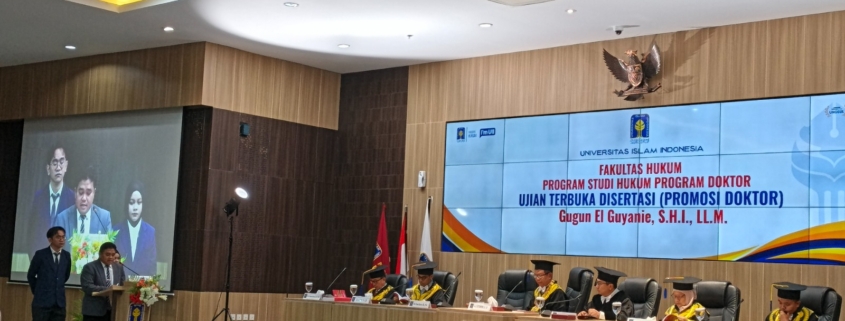
Sleman, Saturday, January 31, 2026, 10.00 WIB, located in the Auditorium on the 4th floor of the Faculty of Law Universitas Islam Indonesia, Gugun El Guyanie successfully obtained his 202nd Doctorate from the Law Study Program, Doctoral Program, Faculty of Law Universitas Islam Indonesia after defending his dissertation entitled "Reformulation of the Regulations for Filling Regional Head Positions in Post-Reform Indonesia".
In his dissertation, Professor Emil examines the reformulation of regulations governing the filling of regional head positions in post-reform Indonesia. This research aims to examine the regulations governing the filling of regional head positions in post-reform Indonesia, assess the urgency of reformulating these regulations, and identify a future regulatory design based on ius constituendum.
Promovendus presented the results of his research in front of the examiners that: (1) Post-reform, the formation of the law experienced dynamics; from indirect regional elections (1999), to direct elections (2004), back to indirect regional elections (2014), rejecting indirect regional elections from 2014 until now. These dynamics are influenced by the electoral political configuration: who won the election, what the coalition and opposition map was like after the election. Meanwhile, in the path of constitutional interpretation, namely the Constitutional Court as the final interpreter of the constitution, since its inception there has never been a decision stating that direct regional elections are unconstitutional, so this means that the Constitutional Court has always been consistent in supporting direct regional elections; (2) Reformulation or re-arrangement of filling regional head positions has found its urgency after the reform by understanding that democracy accommodates regional diversity and looks at legal culture, not by applying a uniform election model. (3) The design for filling regional head positions after the reform is ius constituendum is to maintain and develop an asymmetric model, including election and non-election. Model election can be implemented with three models: direct election, indirect election and specific election. While the model non-election can be translated into two models: appointment and appointment. This means that the direct election model is not the most democratic model, on the contrary the direct election model is not the most democratic model. non-election and indirect elections do not mean undemocratic.
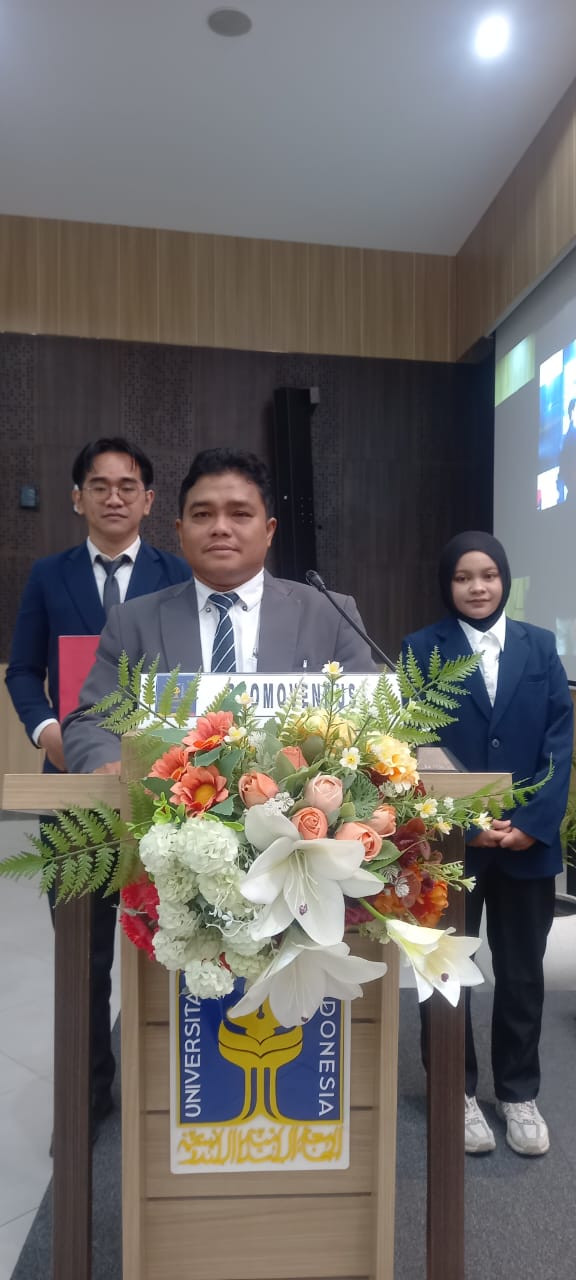 At the end of his dissertation, the professor recommended that legislators (the House of Representatives and the President) maintain and develop an asymmetric model for filling regional head positions, taking into account regional diversity, both in terms of history, human resources, regional budget capacity, and potential for conflict and vulnerability. The Constitutional Court, which has the final interpretative function, should interpret and democratically fill regional head positions by considering regional diversity and the various historical factors behind a region, so as not to be trapped in a black-and-white perspective. Policymakers, researchers, or academics need to conduct a more detailed and comprehensive study regarding regional clustering, and why these regions are categorized as advanced with the recommended model. direct election, on the other hand, why are other areas included in the lagging category with model recommendations? indirect election.
Gugun El Guyanie successfully completed his dissertation under the guidance of Promoter Prof. Dr. Suparman Marzuki, SH, M.Si., Co Promoter Dr. Idul Rishan, SH, LL.M. Present as examiners in the open examination were Prof. Dr. M. Syamsudin, SH, M.Hum., as the chief examiner and the examiner members were, Prof. Purwo Santoso, MA, Ph.D., Dr. Abdul Gaffar Karim, SIP, MA, Prof. Dr. Ni'matul Huda, SH, M.Hum., and Dr. Jamaludin Ghafur, SH, MH