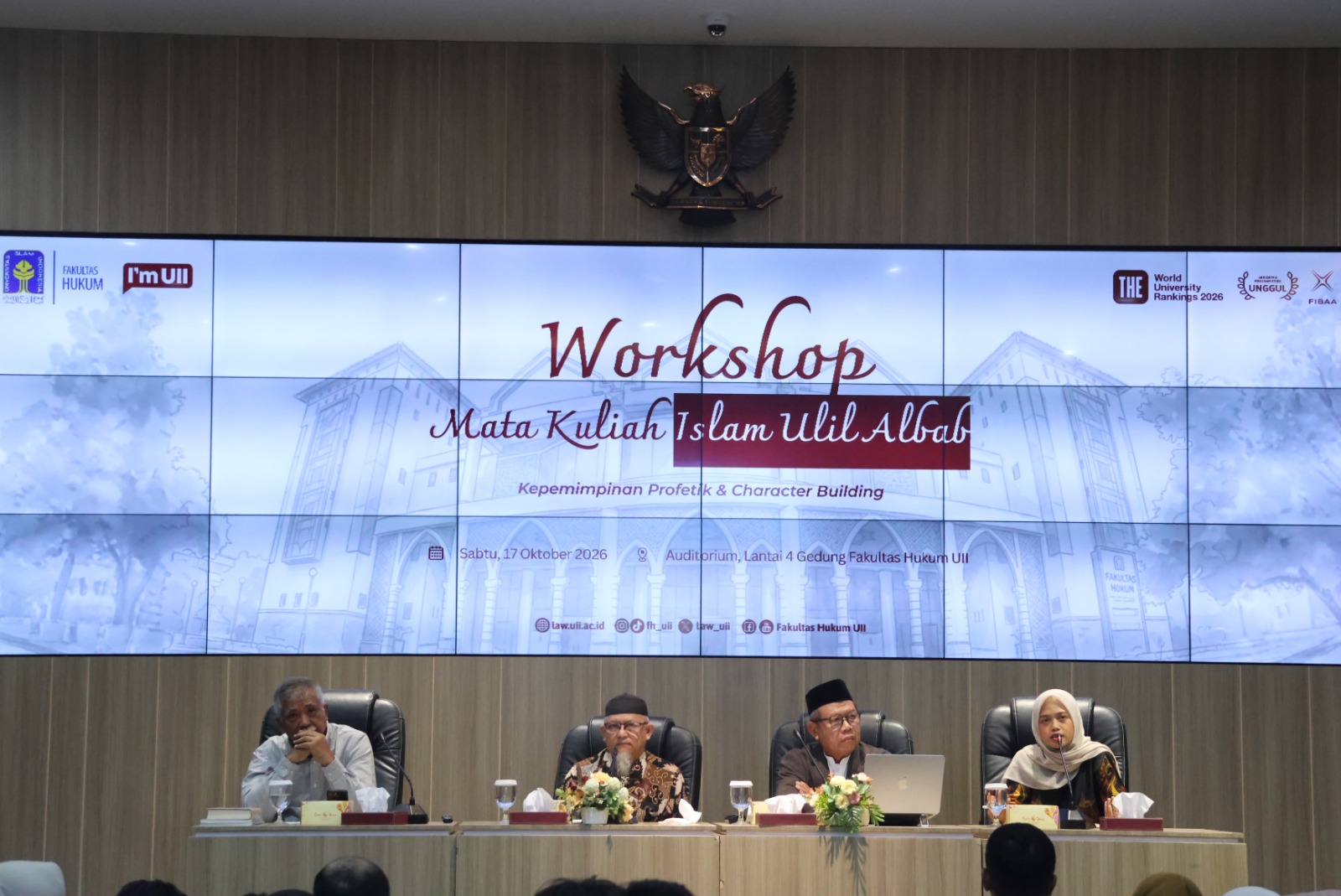
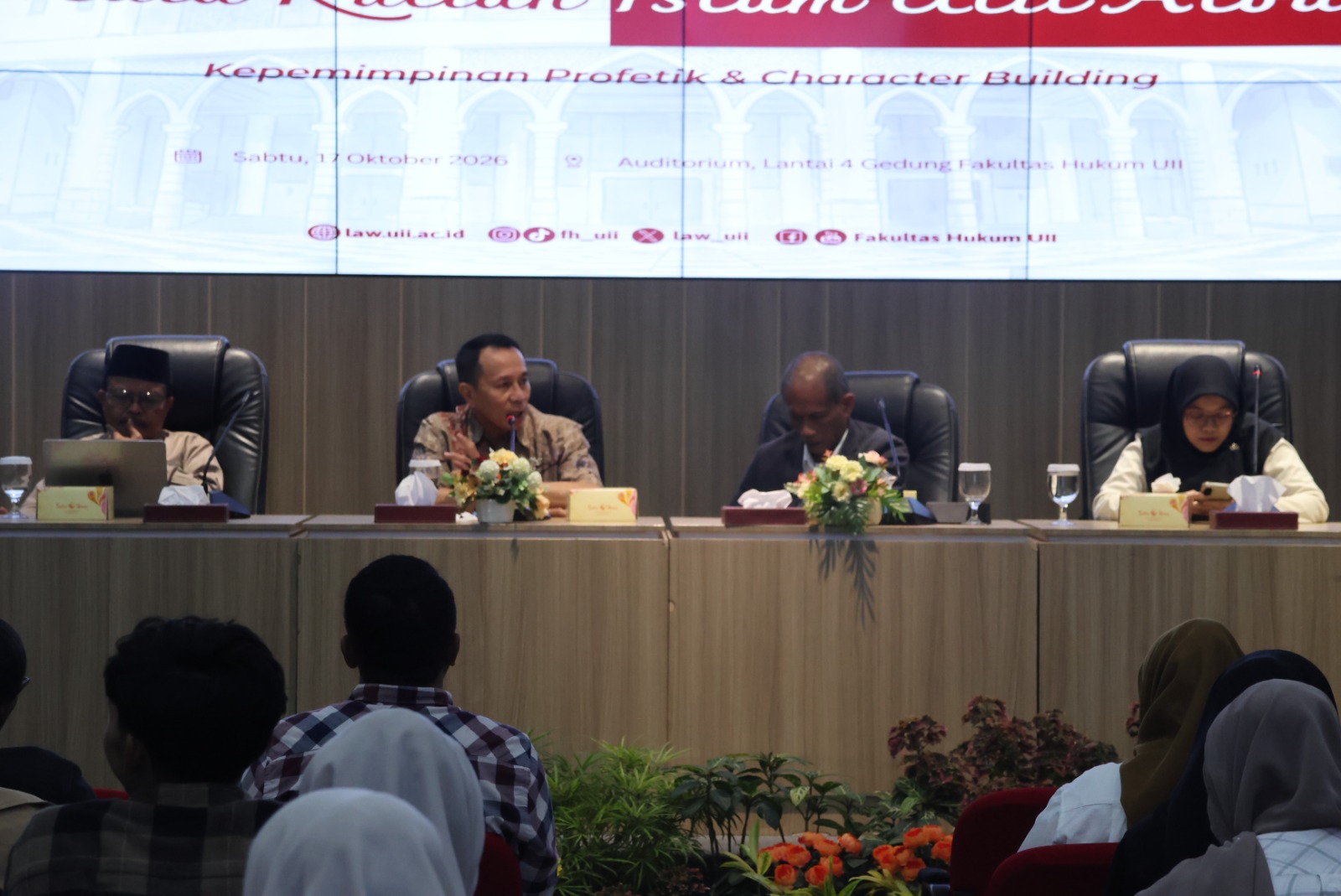
Yogyakarta — Faculty of Law Universitas Islam Indonesia (FH UII) held a Workshop and Character Building for the Ulul Albab Islamic Course on Saturday-Sunday, October 17-18, 2026. This activity was designed in two main agendas, namely a prophetic leadership workshop on the first day and activities outbound and character building on the second day. Through this series of activities, students are expected to develop not only intellectual and professional skills, but also integrity, resilience, concern for others, and the ability to make decisions oriented toward the common good.

The activity was attended by students of the Doctoral Program of Law Study, the Masters Program of Law Study, and the Masters Program of Notary Study of the Faculty of Law UII. Also present and giving remarks were the Dean of the Faculty of Law UII, Drs. Agus Triyanta, MA, MH, Ph.D., along with the heads of study programs, namely Prof. Dr. Ni'matul Huda, SH, M.Hum., Dr. Idul Rishan, SH, LL.M., and Dr. Ariyanto, SH, CN., MH. The presence of the heads of the faculty and study programs emphasized the importance of character building as an integral part of higher legal education.

Integrity and resilience are irreplaceable values

In his remarks, the Dean of the Faculty of Law at UII, Drs. Agus Triyanta, MA, MH, Ph.D., emphasized the importance of preparing students for changes in the workplace resulting from developments in digital technology and artificial intelligence (AI). He stated that as more jobs face the potential for automation, integrity and resilience remain crucial human qualities.

He reminded UII Law students that they must become individuals who uphold noble values. Integrity is not merely a moral identity, but rather a quality that makes someone trusted and needed in a professional environment. In this context, UII Law has a responsibility to ensure that education produces not only graduates with legal knowledge but also individuals with strong values ​​and principles.

The Dean also emphasized that higher education should not be viewed solely as an institutional activity focused on financial gain. There are noble values ​​and ideals that must be championed through education, including the development of individuals with integrity and social responsibility.

In addition to integrity, resilience is a crucial character trait that students need to develop. Facing change, pressure, and complex challenges requires resilience, adaptability, and a willingness to continuously learn. Through the Ulul Albab Islam course, these values ​​are expected to be firmly ingrained, serving as valuable assets for students in their academic and professional lives.

The Dean also emphasized the tradition of freedom that is part of the UII Faculty of Law's identity. Freedom to express aspirations and opinions must be nurtured within a responsible academic environment. Students are expected to think critically, express ideas, and make their best contributions while upholding ethics and humanitarian values.
Enriching legal leadership perspectives

The workshop on the first day presented a number of academics and experts who discussed legal leadership from the perspectives of prophecy, humanity, nationality, technology, and ethics. Prof. Dr. Suparman Marzuki, SH, M.Si., through the material "Prophetic Legal Leadership", highlighted the importance of prophetic values ​​as the foundation of leadership in the legal field. The values ​​of siddiq (honesty), amanah (trustworthiness), tabligh (conveying the truth), and fathanah (intelligent and wise) serve as guidelines for developing legal leaders who are not only competent, but also have moral responsibility. Prof. Dr. rer. soc. Masduki, S.Ag., M.Si., discussed "Humanization, Liberation and Transcendence in Leadership". This material emphasized that leadership needs to be directed to glorify human dignity, free society from injustice, and be based on spiritual and moral values. Good leadership is not only measured by success in achieving targets, but also by its impact on humans and the social environment. Dr. Drs. Asmuni, MA, through his presentation on "Islam, Leadership, and Nationality," connected Islamic values ​​with national responsibility. Legal leadership must be able to reconcile religious values, Pancasila, the constitution, and the principles of the rule of law in an effort to achieve justice and the public good. Thus, Islamic identity and national commitment can strengthen each other in professional life.

In the next session, Dr. Yudi Prayudi, S.Si., M.Kom., discussed “Leadership in the AI ​​Era: Technology Development, Maintaining Values, and Building Civilization.” This material highlighted the changing role of AI from a mere tool to a technology that influences the decision-making process. AI can assist legal work and increase efficiency, but it does not eliminate human responsibility for decisions and their impacts. Leaders must continue to check the accuracy of information, maintain data confidentiality, anticipate bias, and ensure technology is used fairly and responsibly. Dr. Suwarsono Muhammad, MA, delivered the material “Humanization of Law and Just Leadership.” This discussion reminded us that law is essentially intended for humans. Therefore, the application of law and leadership must consider human dignity, social conditions, and protection of vulnerable groups. Law should not stop at formal compliance with rules, but must also bring justice in real life. Meanwhile, Prof. Dr. M. Syamsudin, SH, MH, in his presentation "Islamic (Prophetic) Legal Ethics and Public Interest," explained the concept of public interest as a crucial orientation in establishing and implementing law. Public interest is related to efforts to bring about goodness while preventing harm. From a prophetic legal perspective, the principles of humanization, liberation, and transcendence serve as the foundation for protecting human dignity, reducing injustice, and ensuring that legal implementation is grounded in moral values ​​and responsibility to Allah SWT.

From insight to leadership practice

This series of materials demonstrates that future legal leadership requires a combination of scientific mastery, managerial skills, integrity, and social sensitivity. Mastery of technology must go hand in hand with the ability to assess risks and their impacts. Likewise, authority within the legal profession must be exercised with integrity, fairness, and a focus on the public interest.

The second day's activities continued with outbound activities and the Prophetic Leadership Challenge . Through experiential learning, participants were encouraged to develop teamwork, communication, problem-solving, decision-making, and challenge-solving skills. This approach complemented the conceptual learning on the first day with hands-on experiences that could be applied to their academic and professional lives.

As part of character building, students are also guided to formulate a personal commitment to implementing prophetic leadership values. This commitment is expected to serve as a reminder that the values ​​of honesty, trustworthiness, intelligence, responsibility, and caring are not confined to lectures but are embodied in daily actions.

Through the Ulul Albab Islamic Character Building Workshop and Program, the Faculty of Law (FH) of the University of Indonesia (UII) affirmed its commitment to producing law graduates who are not only intellectually superior but also possess integrity, humanity, adaptability, resilience, and a focus on the common good. These values ​​are expected to serve as a foundation for students in navigating the digital transformation and contributing to building a more just legal and societal life.

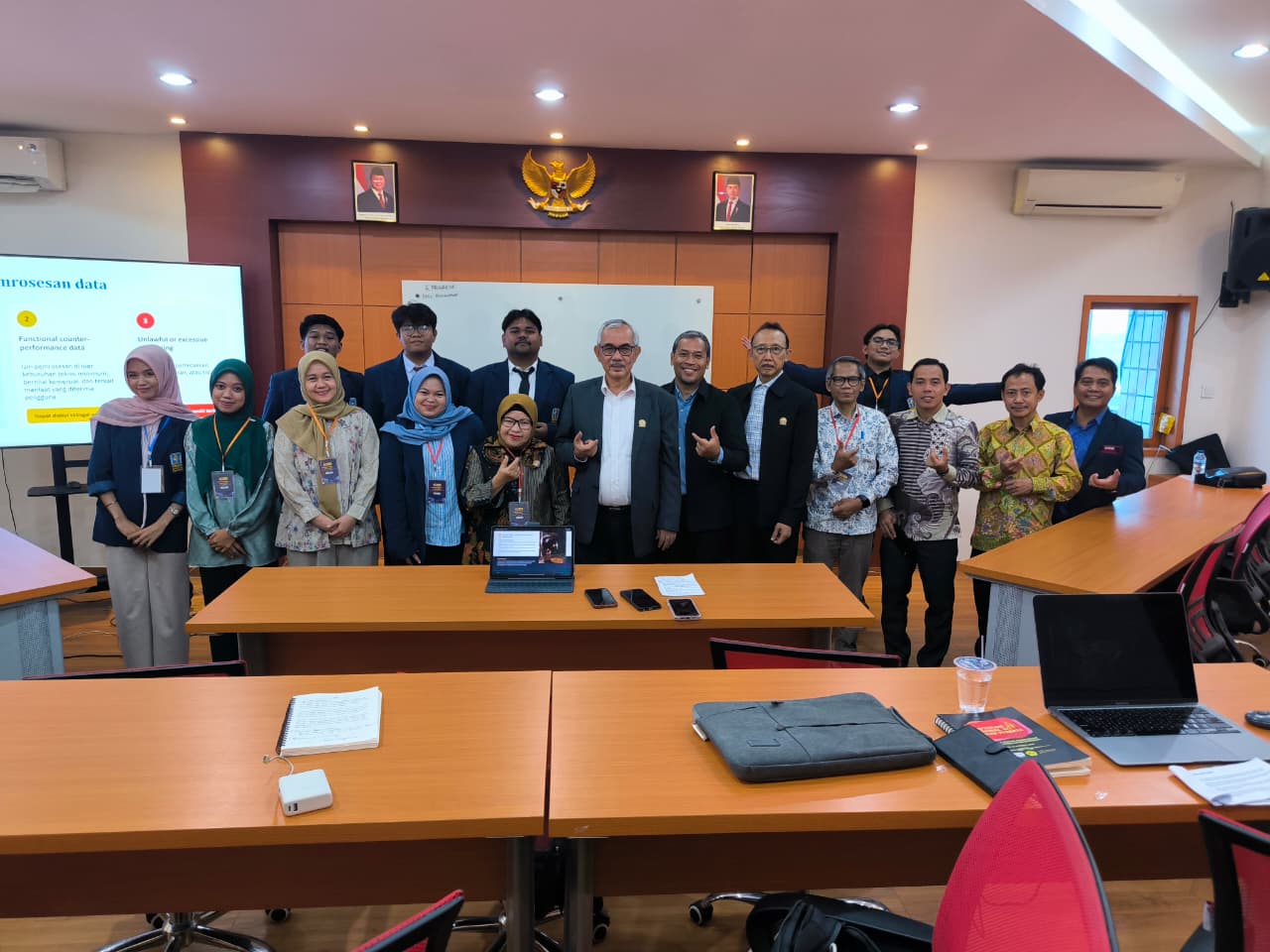
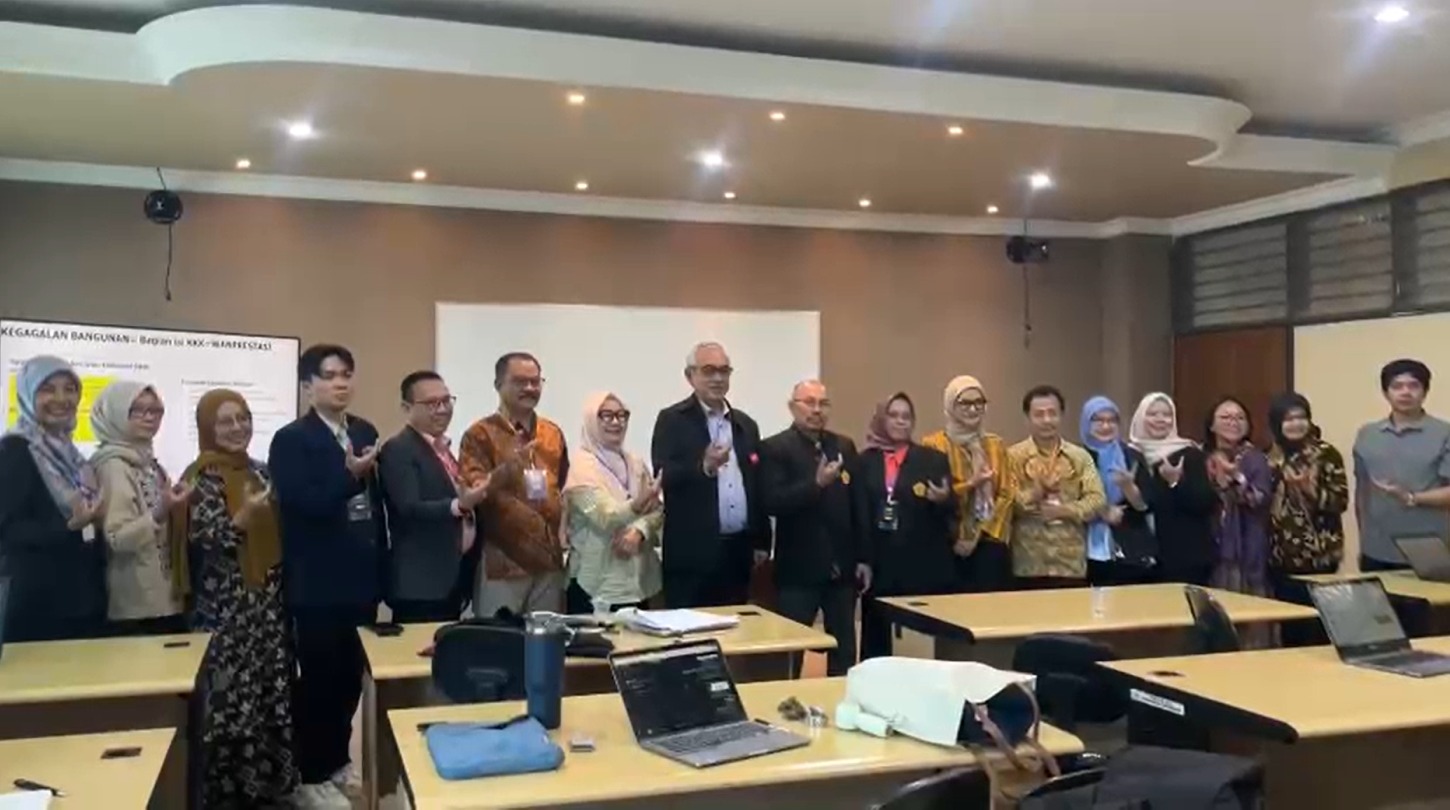
Jakarta (Saturday, October 17, 2026)— Students of the Notary Public Study Program, Masters Program (PSKPM), Faculty of Law Universitas Islam Indonesia (FH UII) participated in the 11th National Conference on Civil Law organized by the Association of Civil Law Lecturers (APHK) on October 15–16, 2026, at Borobudur University, Jakarta. The conference raised the theme "Principles of Reforming Indonesian Contract Law," a strategic theme that addresses the need for civil law reform in the face of technological developments, changing transaction patterns, and the increasing complexity of legal relations in society.
Participation by students at the Faculty of Law (UII)'s PSKPM (Public Law Student Forum) provides a valuable opportunity to broaden their horizons, enhance their intellectual abilities, and develop skills in presenting legal issues and seeking solutions through scientific study. This forum brings together academics, researchers, and legal practitioners from various universities and institutions. Through paper presentations, discussions, and critical reviews from fellow participants, students gain experience in testing legal arguments, refining research methods, and developing recommendations relevant to the needs of national legal reform.

Raising legal issues from the development of society

One of the key values ​​of this conference is the opportunity for students to understand that legal issues extend beyond reading existing regulations. Technological developments and societal practices can give rise to new issues that require interpretation, conceptual development, and even normative reform. Through an academic forum, these issues are openly discussed, examining the legal basis, consistency of arguments, relevance of theories, and potential applications.

The experience of attending conferences also introduces students to an academic culture that places criticism as an integral part of the scientific development process. Feedback on titles, problem formulations, research methods, discussions, and conclusions serves as a means to improve the quality of scientific work. Thus, this activity serves not only as a platform for presenting research results but also as a learning process in developing measurable arguments, open to correction, and scientifically accountable.

Contribution of the PSKPM FH UII delegation

The delegates of PSKPM FH UII, Zidni Farhan Zidan and Siti Azzura raised the theme "Digital Revolution and Updates to Indonesian Contract Law: Cyber ​​Notary and Electronic Deeds". This study discusses the relationship between the development of technology-based notary services and the need for updating contract law. The research highlights the relationship between the regulation of Notary Positions and electronic documents, while identifying normative issues regarding digital subjects and objects, electronic agreement mechanisms, and the responsibilities of the parties in the digital ecosystem. This study emphasizes the importance of legal reform that is responsive to societal developments, while still paying attention to legal certainty and protection of the parties. The second presenter from PSKPM FH UII was Az Zahra Vasha Masruchi, who examined “Ius Constituendum Hybrid Contract in International Trade”. This research examines hybrid contracts that combine written clauses with programming code that can execute commands automatically through smart contract technology. The main problem arises when the implementation of the computer code is not in line with the intent and agreement of the parties in the written clause. This study proposes that textual clauses should have primary position in interpreting the will of the parties, while programming code functions as a technical instrument of implementation. This discussion provides a perspective on the importance of legal certainty in technology-based international trade. Followed by Shafa Ataina Aurellia and Rina Meila Putri discussing "The Absence of Hardship Norms in Long-Term Agreements: The Urgency of Updating Indonesian Contract Law and Its Implications for the Preparation of Notarial Deeds". The study highlights fundamental changes in circumstances that could upset the balance of the contract, even if performance is still possible. This research emphasizes the need for clearer parameters to assess hardship circumstances, including changes that are beyond the control of the parties, cannot be reasonably foreseen, and fundamentally alter the contractual balance. In notarial practice, one implication is the importance of considering hardship clauses as a risk anticipation instrument in drafting long-term agreements. In another chamber, Erfani Melisa Siregar, Anggita Satya Putri, and Zhafran Yasser Pratama raised the issue of "The Urgency of Updating Contract Law in Digital Standard Agreements: Its Relation to the Absolute Exoneration Clause in Roblox Asset Transactions." This study uses digital asset transactions on the Roblox platform as a context to discuss the imbalance of bargaining power in standard agreements. Problems arise when platform providers have broad authority to change or revoke access to digital assets, while users have no comparable negotiating space. The study emphasizes the importance of the principles of balance and consumer protection in the renewal of contract law, so that digital innovation continues to run while paying attention to fairness and certainty of the rights and obligations of the parties.

The diverse topics explored by delegates demonstrated that notarial and contract law issues are increasingly intertwined with technological developments, digital commerce, and the complexity of contractual relationships. The issues discussed also demonstrated the need to connect legal theory with practice, while developing more concrete and implementable recommendations.

Directions for updating contract law from experts

The conference began with an opening ceremony, which included remarks from the leaders of Borobudur University and the Indonesian Academy of Law (APHK), as well as a keynote address by the Chief Justice of the Supreme Court. The placement of the keynote address in this forum emphasized the importance of reforming contract law as part of efforts to strengthen the national legal system. This reform needs to address the dynamics of legal relations in society without neglecting legal certainty, justice, and expediency. A specific summary of the Chief Justice's message should refer to the content of the speech delivered at the event.

Perspectives on the direction of national contract law reform.

In succession, the presenters at the APHK National Seminar, Prof. Dr. Y. Sogar Simamora, SH, M.Hum., through the material "Main Ideas on the Direction of National Contract Law Reform", raised the importance of determining the direction and basic principles of contract law reform. The main issue that needs to be answered is how to build a national legal framework that is able to provide certainty while adapting to developments in society and contractual practices. Prof. Dr. Anwar Borahima, SH, MH, discussed "The Concept of Juridical Act in the Reform of Indonesian Contract Law". This material places the concept of legal acts as one of the foundations for organizing the relationship between will, legal actions, and the resulting legal consequences. Conceptual clarity is important so that the regulation of contracts has a consistent basis and can be applied to various forms of legal acts. Prof. Dr. Faisal Santiago, SH, MM, delivered the material "Regulation of Cancellation/Cancellation of Legal Acts in the Reform of Indonesian Contract Law". The discussion on the cancellation and nullification of legal acts relates to certainty regarding the validity of legal relationships and the consequences that arise when a legal act does not meet the specified requirements. Regulatory updates need to clarify the legal basis, mechanisms, and consequences so that protection for the parties can run proportionally. And Prof. Dr. Nindyo Pramono, SH, MS, as the final speaker on the first day of the APHK conference raised "Prospects for Commercial Law Regulations in the Reform of Indonesian Contract Law (Position of the Commercial Code after Contract Reform)". This material underscores the importance of seeing the relationship between contract law and commercial law in the process of national legal reform. Arranging the relationship between provisions is necessary so that the regulation of transactions and trade activities has a clear, consistent system, and is in accordance with the needs of business practices.

Principles of contracts, electronic legal acts, factors influencing contracts, and non-contractual obligations.

Prof. Dr. Johannes Gunawan, SH, LL.M., through the material “Principles of Contract Law in the Reform of Indonesian Contract Law”, highlighted the importance of contract law principles as a foundation for the formation and implementation of contractual relationships. Legal reform needs to ensure that these principles remain able to maintain the balance of the interests of the parties and provide clear guidelines in practice. Continued by Prof. Dr. H. Joni Emirzon, SH, M.Hum., discussing “Regulation of Legal Acts through Electronic Media within the Framework of Indonesian Contract Reform”. This material is relevant to changes in the way society forms and implements legal relationships through digital means. The challenge is to ensure that legal validity, proof, and accountability can be applied adequately when legal acts are carried out electronically. Prof. Dr. Agus Yudha Hernoko, SH, MH, emphasized “Regulation of the Working Power of Autonomous and Heteronomous Factors in Contracts”. This theme relates to the relationship between the freedom of the parties to determine the contents of the contract and the limitations set by law. Freedom of contract remains important, but its implementation needs to take into account the protection of the weaker party as well as legal provisions that maintain public interests and contractual balance. And the final discussant, Prof. Dr. Rosa Agustina, SH, MH, discussed "The Principles of Reforming Non-Contractual Engagement Law". This material expands attention from legal relationships that arise based on agreements to contractual relationships that arise on other legal grounds. Reforms need to provide a clear framework for determining the basis of liability, the elements that must be proven, and the forms of protection available to injured parties.

Expert discussions demonstrate that reforming Indonesian contract law requires a comprehensive approach. This reform encompasses not only refinement of the wording of norms, but also clarity of basic concepts, consistency between provisions, regulation of electronic legal relations, balance within contracts, and legal protection in both contractual and non-contractual relationships.

Notary students gain experience directly relevant to the needs of the profession. Notaries are required not only to understand legal provisions but also to analyze the intentions of the parties, identify risks, draft appropriate legal instruments, and anticipate potential disputes. The ability to discuss and accept criticism academically provides the foundation for improving the accuracy and quality of legal reasoning in professional practice.

Strengthening academic culture and scientific networks

Participating in the 11th National Conference on Civil Law provides enrichment learning for students of the Faculty of Law (FH UII)'s PSKPM. The experience of interacting with academics and researchers from various institutions broadens their perspectives and introduces them to developments in civil law thought and the agenda for national legal reform.

Through this activity, students are expected to become more accustomed to identifying emerging legal issues in society, constructing arguments based on scientific methods, and offering solutions that go beyond normative ideas and also consider practical needs. This experience is expected to support the development of notary graduates who are critical, adaptive, and possess integrity, and able to contribute to the development of Indonesian law.

Participation in the conference is also expected to strengthen the academic culture within the Faculty of Law's Student Affairs and Research Center (PSKPM) at UII, particularly by encouraging quality research, scientific collaboration, and student involvement in national scientific forums. Therefore, this event is not only a two-day experience but also part of the ongoing process of building students' intellectual and professional capacity.

Yogyakarta — (Saturday, October 17, 2026) Master of Law Students Association (IMAMAH) Faculty of Law Universitas Islam Indonesia (FH UII) held the inauguration of the 2026–2027 management as a momentum to strengthen the role of student organizations in building leadership, developing personal capacity, and supporting academic success.
This activity was attended by the Deputy Dean for Islamic Affairs, Student Affairs, and Alumni of the Faculty of Law UII, Dr. Jamaludin Goffur, SH, MH, and the Head of the Master's Program in Law, Dr. Idul Rishan, SH, LL.M. The presence of the faculty and study program leaders is a form of support for the development of student organizations within the Master of Law program at the Faculty of Law UII.

In their remarks, the committee representatives expressed their gratitude to the UII Faculty of Law leadership, particularly Dr. Jamaludin Goffur and Dr. Idul Rishan, who attended and supported the inauguration. They also expressed their appreciation to the entire committee for their hard work overseeing the preparations and ensuring the event's successful implementation.

He stated that organizing this event was more than just preparing for the inauguration ceremony. The process involved a long journey, starting with the General Assembly (Mubes), drafting the IMAMAH Constitution and Bylaws (AD/ART), and ending with the post-inauguration work coordination meeting (rakorja). This series of events is crucial for building the organization's foundation, agreeing on its direction, and formulating the new management's work program.

In his remarks, Dr. Jamaludin Goffur emphasized the importance of organizational participation as a means of developing soft skills , particularly leadership, communication, collaboration, and managerial abilities. He believed that organizational experience can provide students with a platform to hone their skills, test their abilities, and learn to face real-life responsibilities.

However, he cautioned against using organizational activities as an excuse for delayed study completion. Organizations should be aligned with academic responsibilities, not a scapegoat for delays in study.

"Students who are active in organizations must be able to be role models for other students. Organizational activities should strengthen the ability to manage time, complete responsibilities, and achieve academic achievements," was the message emphasized in his speech. Jamaludin Goffur congratulated the IMAMAH 2026-2027 Management Board chaired by Musmulyadin, SH. Other daily management boards are Deputy General Chair Muhammad Nur Adnan Sauridi, SH, General Secretary Bima Sena Putra Asmara, SH, Deputy General Secretary Adelia Ariyanto, SH, General Treasurer Zuleka Rohmah Yantika, SH. The organizational structure is 7 Divisions, namely the Human Resources Development Division, Strategic Studies Division, Network and Advocacy Division, Legal Analysis and Public Policy Division, Training Studies Division, Media and Publication Division, and Physical and Spiritual Fitness Division.

He hopes the IMAMAH management can demonstrate that organizational involvement and academic success can go hand in hand. With effective time management, program planning, and effective division of responsibilities, the organization can become a leadership laboratory that supports students' success in pursuing their master's degree.

The inauguration of the 2026–2027 management is expected to mark the beginning of IMAMAH's efforts to strengthen organizational governance, improve the quality of its work programs, and provide beneficial activities for Master of Law students at the Faculty of Law, University of Indonesia (UII). Through the new management, IMAMAH is expected to become not only a gathering place but also a platform for leadership learning, intellectual development, and strengthening academic culture.

Ultimately, the success of an organization is not only measured by the number of activities held, but also by its contribution in forming students who have integrity, are skilled, achieve, and are able to complete their studies well.

A Visiting Professor from the Faculty of Law at UII Invites Dicle University Academics to Discuss Intercultural Mediation and the Aegean Sea Dispute

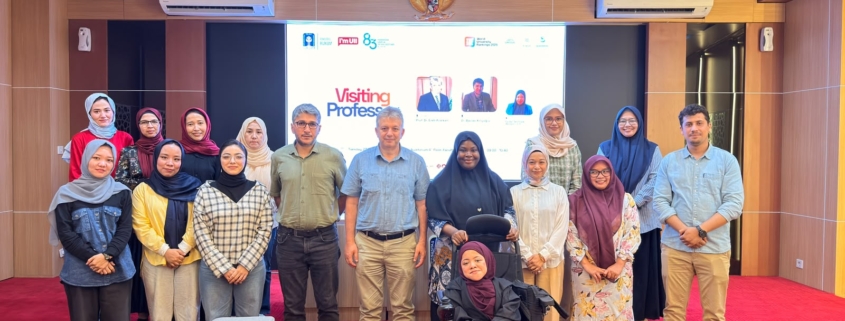
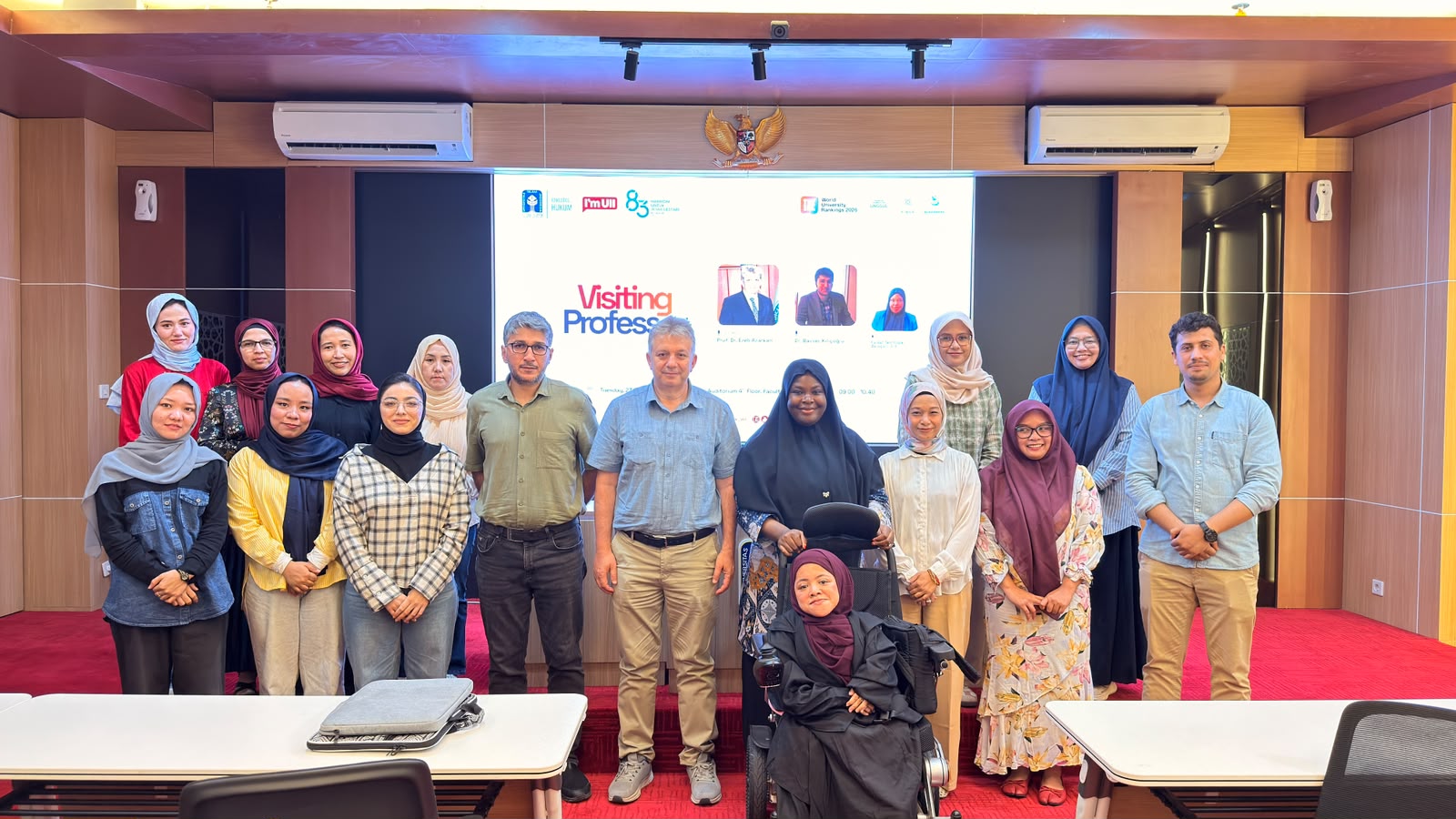
Group photo after the public lecture

Yogyakarta, 23 June 2026 - Faculty of Law Universitas Islam Indonesia (FH UII) is again strengthening its international network by holding activities visiting teachers which presented two academics from Dicle University, Türkiye, namely Prof. Dr. Ezeli Azarkan and Dr. Bavver KılıçoğluThe event, which took place on the 4th floor of the UII Faculty of Law, was attended by students from the Master's Program in Law who were enthusiastic about exploring contemporary international legal issues.

The event opened with remarks by the Head of the Master's Law Study Program , Prof. Dr. Sefriani, SHMHum., and moderated by Faidat Temitope Balogun, SH , a first-semester student in the Master's Law Study Program, Faculty of Law, UII. The event took place interactively with a presentation session followed by a discussion and question and answer session between participants and the speakers.

In the first session, Dr. Bavver Kılıçoğlu , Assistant Professor at the Department of International Law at Dicle University, presented the topic “The Positive Effects of Intercultural Mediation, as Accepted in the European Union, on Migrant Integration Policies.” He explained how the intercultural mediation approach implemented in the European Union can be an important instrument in supporting migrant integration, reducing social conflict, and strengthening the cohesion of multicultural societies. This material provides insights into the relationship between public policy, human rights, and migration governance in a global context.

Next, Prof. Dr. Ezeli Azarkan , Head of the Department of International Law at Dicle University, delivered a presentation entitled “Aegean Sea Disputes between Turkey and Greece.” In his presentation, he reviewed the historical roots and international legal aspects behind the Aegean Sea dispute between Turkey and Greece, including the issue of maritime territorial delimitation and its implications for regional stability. Participants gained a deeper understanding of the complexity of international dispute resolution and the role of international law in maintaining peace between countries.

The discussion session was interactive, with students raising various questions regarding the implementation of intercultural mediation in various countries and developments in maritime dispute resolution in Europe. This intensive interaction demonstrated the participants' strong interest in international legal issues relevant to current global challenges.

Through this Visiting Professor program, the UII Faculty of Law hopes to broaden students' academic perspectives, improve the quality of international-based learning, and strengthen collaboration with international higher education institutions. This activity also represents UII's commitment to supporting the internationalization of higher education and the development of legal scholarship that is responsive to global developments.

#FHUII #VisitingProfessor #InternationalLaw #DicleUniversity #LawUII

Universitas Islam Indonesia (UII) as a pioneer of higher education in Indonesia with more than 70 years of experience, committed to producing future leaders through superior educational programs based on Islamic and national values, opens opportunities to Master/Doctorate to join as a Regular Permanent Lecturer Universitas Islam Indonesia April 2024 period.

Recruitment procedures and conditions can be accessed via the UII Lecturer Recruitment Page.

For further information, please contact the Directorate of Human Resources/Leadership School, GBPH Building, Prabuningrat, 2nd floor, UII Integrated Campus, Jl. Kaliurang Km. 14,5 Yogyakarta, Tel. 0274-898444 ext. 1227 or 1229.

Warning: Recruitment of Regular Permanent Lecturers Universitas Islam Indonesia no fees charged and no system used refund or reimbursement of transportation and accommodation costs related to the implementation of recruitment and please ignore parties who promise to help recruit participants pass.

STUDENT PARK; On Friday and Saturday, October 22-23, 2021, Faculty of Law Universitas Islam Indonesia has conducted an Intensive Lecture activity with Members of the Indonesian House of Representatives. The theme carried in this activity is "Intensive Lecture on the Formation of Legislation of the Faculty of Law UII (Legislation Practice as a Reflection of Democracy in Draft Laws)". This activity is held every semester to provide additional material in the Formation of Legislation course and to create human resources, especially graduates of the Faculty of Law UII who are reliable in the field of legislation and can apply it in actual practice.

This intensive lecture activity was attended by 282 participants consisting of students of the Formation of Legislation course, Odd Semester of the 2021/2022 Academic Year, lecturers, teaching assistants for the Formation of Legislation course and leaders of the UII Faculty of Law and the Organizing Committee. This activity was divided into (two) days with speakers from each faction, namely Emmanuel Josafat Tular, S.IP., M.Sc. (NasDem Party Faction), Dr. H. Saleh Partaonan Daulay, M.Ag., M.Hum., MA, Yusran Isnaini, SH, M.Hum. (PAN Party Faction), Erlanda Juliansyah Putra, SH, MH, Ali Slamande, SH, LLM. (PKS Party Faction).

On Friday, October 22, 2021, the intensive lecture began at 1:30 PM WIB and ended at 4:00 PM WIB. The event opened with remarks from the Head of the Undergraduate Law Study Program (PSHPS) of the Faculty of Law, UII, Prof. Dr. Budi Agus Riswandi, SH, M.Hum., followed by a presentation by Mr. Emmanuel Josafat Tular, S.IP., M.Si., an expert from the NasDem faction.

Saturday, October 23, 2021, was divided into 2 sessions, namely session 1 at 07.30 to 10.15 WIB the event was opened with remarks from the Head of the Undergraduate Law Study Program (PSHPS) FH UII by Prof. Dr. Budi Agus Riswandi SH, M.Hum. which was followed by a presentation of material by Erlanda Juliansyah Putra, SH, MH, and Ali Salmande, SH, LLM. as an expert from the PKS Faction. Before the closing ceremony, a member of the Indonesian House of Representatives from the PKS Faction and Deputy Chair of the PKS Faction by Sukamta, Ph.D. delivered his remarks. While Session II was held at 08.45 to 11.15 WIB the event was opened with remarks from the Head of the Undergraduate Law Study Program (PSHPS) FH UII by Prof. Dr. Budi Agus Riswandi SH, M.Hum. which was followed by a presentation of material by Dr. H. Saleh Partaonan Daulay, M.Ag., M.Hum., MA, Yusran Isnaini, SH, M.Hum. As expert staff for the PAN faction.


In this intensive lecture, the speakers conveyed the stages of the formation of laws as regulated in Law No. 12 of 2011 concerning the Formation of Legislation as amended by Law No. 15 of 2019 which includes the stages of planning, preparation, discussion, ratification, and promulgation. In addition, the speakers also conveyed in detail the stages of discussion of a draft law starting from Level I Discussion and Level II Discussion or decision making. The speakers also conveyed the current process of forming laws such as the process of forming the Job Creation Law, the Sexual Violence Crime Bill (TPKS) and other laws which made this material session more interesting.

After each presentation, students were given the opportunity to ask the presenters questions directly about the material and current issues related to the topic. The students' enthusiasm for this intensive course was evident in the numerous questions they posed to the presenters, both in person and through the Zoom chat room, and related them to real-life cases related to the drafting of the bill.


The UII Faculty of Law hopes that this activity, particularly the one with the Indonesian House of Representatives (DPR RI) in the legislative drafting course, can continue every semester, even though it will be online due to the COVID-19 pandemic. The UII Faculty of Law hopes that when all community activities, especially the lecture system, return to normal, we can hold this activity in person at the DPR RI Building in Jakarta.


YOGYAKARTA, July 10, 2021, Faculty of Law, University of Indonesia (UII) – The Criminal Justice Practice and Civil Justice Practice courses are compulsory study program courses that combine theoretical material with practical work, commonly known as practicums. Before the Midterm Exam (UTS), students are provided with material to support the practicum. After the UTS, students are taught to practice the previously taught material, namely practicing criminal trials, including pre-trial hearings. Meanwhile, in the Civil Justice Practice course, students practice civil trials, including petitions.

The COVID-19 pandemic has transformed the current academic process. Restrictions on large-scale physical meetings have prevented face-to-face learning, significantly impacting lectures, particularly practicums. One practicum affected by the COVID-19 pandemic is the moot court practicum, in which students simulate criminal and civil trials. Prior to the pandemic, moot court practicums were conducted in a special room designed to resemble a courtroom. During the pandemic, moot court practicums are conducted online using the Zoom platform.

The mock trial practice conducted entirely online via Zoom, where each student playing the role of judge, public prosecutor, counsel or attorney, defendant, plaintiff/defendant, clerk, court officer, and other roles are in their respective rooms (separate rooms), certainly does not align with the formulation of the mock trial practice conducted offline (face-to-face). However, on the other hand, this practicum activity cannot be simply eliminated in order to align with one of the objectives of the criminal justice practice and civil justice practice courses, namely students being able to simulate trials.

Simulations of criminal and civil court practices usually use a special room on the UII FH campus which has been provided with visitor chairs, special places for the panel of judges, public prosecutors, counsel or legal counsel, other court attributes that are usually found in real courtrooms and other facilities to support the trial simulation practicum. Then at the final meeting of the simulation, students are usually required to wear uniforms that have been provided as facilities for the criminal and civil court practice simulations, namely judge's gowns, legal advisor gowns, public prosecutor gowns, court officer uniforms, court clerk's suits, and others. However, because all of these facilities can only be accessed at the UII Faculty of Law while students are in their respective regions or outside the city, students still simulate trials using neat clothes and as formal as possible that students can prepare according to the instructions of the lecturer in charge of the course.

While the Zoom platform can be used during the mock trial, several changes must be made, such as using a virtual background that shows the student's position or a plain background that still looks formal or official. Students must still wear neat clothing and be as prepared as possible for the final meeting, but not have their full bodies visible on Zoom. This online mock trial is also guided by lecturers in the criminal justice practice and civil justice practice courses who are practitioners (judges) in judicial institutions. Therefore, the lecturers provide input regarding the online trial process for students to practice during the simulation, while still adapting to available and usable technology.

The current implementation of health protocols, including restrictions on physical gatherings, including lectures, does not justify the elimination of practicals that should be conducted in person. Using the Zoom platform remains the best solution, allowing both lecturers and students to continue practicals, particularly those simulating trials.

YOGYAKARTA, July 10, 2021, Faculty of Law, University of Indonesia (UII ) – The "Formation of Legislation" course is a compulsory course in the study program that combines theoretical material with practical work, commonly known as practicum. Before the Midterm Exam (UTS), students are provided with material to support the practicum. After the UTS, students are taught to put the previously taught material into practice, namely creating academic papers, legal papers (bills/amended bills/draft regional regulations/amended regional regulations), and pseudo-legislation practices.

The COVID-19 pandemic has transformed the current lecture process. Restrictions on large-scale physical meetings have prevented face-to-face learning, significantly impacting lectures, especially practicums. One practicum affected by the COVID-19 pandemic is the mock legislative practice. Before the pandemic, the mock legislative practice was conducted in a designated lecture hall. During the pandemic, the mock legislative practice is conducted online using the Zoom platform.

The online pseudo-legislative practice certainly doesn't align with the formulation of pseudo-legislative practice, which is designed in a single room as if it were a plenary meeting room for council members, compared to the offline (face-to-face) pseudo-legislative practice. However, on the other hand, this practicum activity cannot be simply eliminated to align with one of the objectives of the legislative drafting course, namely, students practicing pseudo-legislative practice.

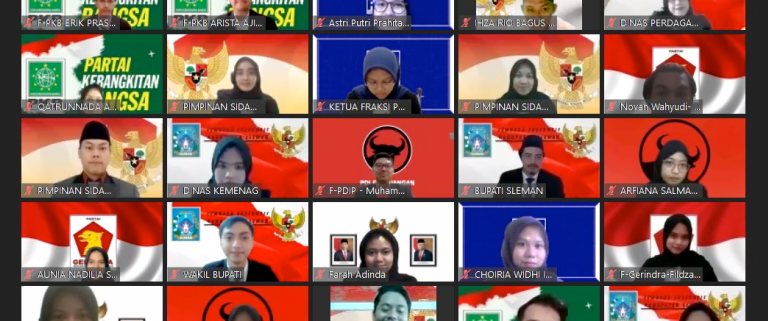
The mock legislative practice usually uses a special room on the UII FH campus for the practice of forming legislation in which a podium has been provided for reading files, a microphone , a gavel for the meeting leader, a name desk and other facilities to support the practicum. Then at the final meeting, the mock legislative practice was carried out in the plenary meeting room that we have requested permission to use for academic purposes, namely in the Yogyakarta City DPRD, Bantul Regency DPRD and Sleman Regency DPRD and students are required to wear official uniforms like council members such as jackets, ties, blazers and others.

The use of the Zoom platform during the mock legislative practice can be done but several things must be changed such as only listening to the national anthem which is usually sung together, because if everyone sings it will interfere with the audio on Zoom, using a virtual background or a plain background that still looks formal or official, still wearing the official uniform during the last meeting but not full body , and so on. This online mock legislative practice is also guided by a lecturer in the course on the formation of legislation who works as a practitioner in the field of the formation of legislation. Therefore, the lecturer provides input regarding the plenary meeting held by members of the council online to be practiced by students in the practicum while still adapting to the available and usable technology.

The current implementation of health protocols, including restrictions on physical gatherings, including lectures, does not justify the elimination of practicals that should be conducted in person. Using the Zoom platform remains the best solution, allowing both lecturers and students to continue practicals, particularly those involving pseudo-legislation.

YOGYAKARTA (FH UII) – On Friday and Saturday, April 9 – 10, 2021 Faculty of Law Universitas Islam Indonesia has carried out activities Intensive Lecture on the Formation of Legislation, Faculty of Law, UII with Legal Darafter with the theme being Techniques for Compiling Systematic LegislationThis activity is held every semester to provide additional material in the course on the Formation of Legislation and to create human resources, especially UII Faculty of Law graduates who are reliable in the field of legislation and can apply it in actual practice.

This intensive lecture activity was attended by 272 participants consisting of students of the course on the Formation of Legislation in the Even Semester of the Academic Year 2020/2021, the Head of the Faculty of Law UII, Lecturers and Assistants of the Course on the Formation of Legislation and the Organizing Committee. This activity was divided into 2 (two) days with speakers Mohammad Zamroni, SH, MH, Wahyu Tri Hartomo, SH, MH, Dr. Hendra Kurnia Putra, SH, MH, Reza Fikri Febriansyah, SH, MH, all speakers are Legal Drafters who work at the Ministry of Law and Human Rights of the Republic of Indonesia.


Friday, April 9, 2021, was divided into 2 sessions, namely session I starting at 08.30 to 11.15 WIB, the event was opened with remarks from the Secretary of the Department of the Faculty of Law UII, Bagya Agung Prabowo, SH, M.Hum., Ph.D. Then, continued with the presentation of material by Mohammad Zamroni, SH, MH and Session II was held at 13.15 WIB to 16.15 WIB the event was opened with remarks from the Dean of the Faculty of Law UII, Dr. Abdul Jamil, SH, MH Then, continued with the presentation of material by Wahyu Tri Hartomo, SH, MH


Saturday, April 10, 2021, was also divided into 2 sessions, the second session began with a speech from the Dean of the Faculty of Law, UII, Dr. Abdul Jamil, SH, MH, namely session I at 07.30 to 10.45 WIB with a presentation of material by Reza Fikri Febriansyah SH, MH and Session II was held at 08.45 WIB to 11.45 WIB with a presentation of material by Dr. Hendra Kurnia Putra, SH, MH

The Dean of the Faculty of Law UII Dr. Abdul Jamil SH, MH in his remarks said that this intensive lecture is part of the learning strategy in the course on the formation of legislation which combines theory and practice to equip students so that students not only know in the theoretical scope but also know the practice directly from related practitioners, but due to the Covid-19 pandemic, this intensive lecture is carried out online (online).

All presenters began their material with the formation of legislation in general and then specifically discussed the techniques for drafting legislation as stated in Appendix II of Law Number 12 of 2011 concerning the formation of legislation, including how to formulate the right words or sentences in draft laws. Reza Fikri Febriansyah SH, MH, one of the presenters on the second day, closed his material with a message that words can change the world, with words can make a guilty person innocent and so on. So that this message can be remembered by everyone, including legal drafters and law students.


After each presentation session, students were given the opportunity to ask the presenters questions directly about the material and current issues related to the topic. The students' enthusiasm for this intensive course was evident in the numerous questions they submitted to the presenters, both in person and via Zoom chat during the Q&A session.

The UII Faculty of Law hopes that this activity will continue every semester, even though the lecture system is currently still being conducted online (online), but the UII Faculty of Law continues to strive to provide the best learning for students.