LEGISLATION WEBINAR SERIES #4
REVIEWING THE AGENDA FOR FORMATION OF MINISTRY AND INSTITUTIONAL REGULATIONS


Source person:
1. Dr. Fitriani Ahlan Sjarif, SH, MH
(Legal Science Lecturer, Faculty of Law, University of Indonesia)
Topic: Study of the Delegation of Laws in Ministerial and Institutional Regulations

2. Dr. Ricca Anggraeni, SH, MH
(Legal Science Lecturer, Faculty of Law, Pancasila University)
Topic: Orderly Authority in the Formation of Ministerial and Institutional Regulations in 2021

3. Muhamad Addi Fauzani, SH, MH
(Researcher of PSHK FH UII)
Topic: Reviewing the Regional Government Implementation Agenda in Ministry and Institutional Regulations

Moderator:
Yuniar Riza Hakiki, SH
(Researcher of PSHK FH UII)

Implementation:
🗓 Thursday, July 29, 2021
⏰3:00 PM - 5:00 PM WIB

📍Zoom Participant Registration Link:
http://bit.ly/WebinarPSHKSeries4

📍Watch Live Streaming at:
https://www.youtube.com/channel/UCUdns9r2xMAyq1RijpioDFA
Don't forget to Like, Subscribe, Comment and Share

☎️Contact Person:
081326128622 (Hatta)
081360671838 (Taufiqurrahman)

PSHK FH UII

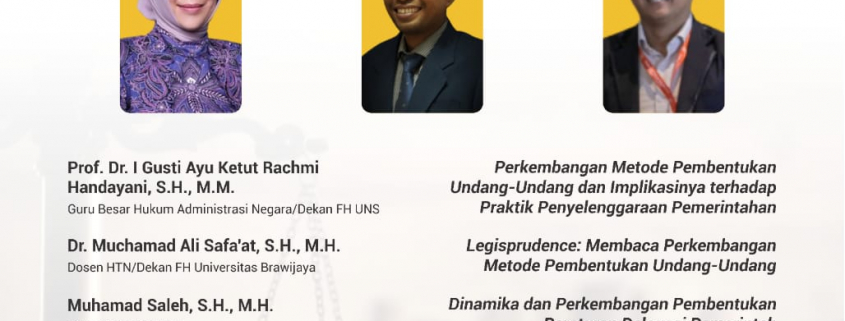
LEGISLATION WEBINAR SERIES #3
DYNAMICS AND DEVELOPMENT OF METHODS FOR FORMING LEGISLATION

Source person:
Prof. Dr. I Gusti Ayu Ketut Rachmi Handayani, SH, MM (Professor of State Administrative Law/Dean of the Faculty of Law, UNS)
Topics: The Development of Methods for Forming Laws and Their Implications for the Practice of Governance

Dr. Muchamad Ali Safa'at, SH, MH (HTN Lecturer/Dean of the Faculty of Law, Brawijaya University)
Topics: Legisprudence: Reading the Development of Methods for Forming Laws

Muhamad Saleh, SH, MH (Researcher at PSHK FH UII)
Topics: Dynamics and Development of the Formation of Government Delegation Regulations

Moderator:
Hatta Muhammad Irsyad (Research Staff of PSHK FH UII)

Implementation:
Wednesday, July 14, 2021
Time: 12.30-14.30 WIB

Zoom Participant Registration Link click
Watch Live Streaming right here.

Don't forget to Like, Subscribe, Comment and Share.

Contact person:
081326128622 (Hatta)
081360671838 (Taufiqurrahman)

__________
Let's get to know PSHK better by following the information in the following media:
📷 Instagram : @pshkfhuii
🐤 Twitter: @pshkfhuii
👍 FP: PSHK FH UII
▶️ YouTube: PSHK FH UII
🌎 website : pshk.uii.ac.id

The current momentum of economic growth and digital investment in Indonesia is valuable and must be maintained. One way to achieve this is by establishing an appropriate legal framework . This legal framework should substantively keep pace with technological developments, guarantee legal certainty and protection, and enhance Indonesia's competitiveness as a digital investment destination.

According to a 2019 report released by Temasek, Google, and Bain&Co, Indonesia's digital economy is expected to grow at a staggering 49 percent annually. The country's e-commerce sector is even predicted to exceed US$130 billion by 2025, making Indonesia one of the world's largest digital economies.

The government, business players, and academics agree that the digital economy is one of the saviors of the national economy during the COVID-19 pandemic. The digital economy has proven to continue growing amidst the sluggishness of various sectors during this pandemic.

Discussions about the digital economy involve discussing two key words: economics and technological innovation. In this regard, it's also fundamentally important to understand that technological innovation always has two sides. The positive side, which offers benefits, and the negative side, which involves various risks and potential losses. In this context, creating a legal framework that can guarantee the sustainability of innovation while providing certainty and protection, is a crucial and fundamental need.

Technological innovation is occurring in nearly every business sector, including the financial services sector. Technological innovation in the financial services sector, known as Financial Technology (Fintech), has become a unique phenomenon in this era. The Fintech era is primarily marked by the emergence of various non-financial technology companies operating in the financial services sector. Meanwhile, the banking sector continues to innovate, giving rise to what is known as digital banking.

The development of the digital economy has also introduced a variety of new transactions and financial services products that are increasingly diverse in the Islamic economy. Some examples include online buying and selling, digital wallets, cashback , and so on. These diverse transactions require a response from the Islamic economy. The digitalization of the Islamic economy can penetrate various aspects of the economy, both micro and macro. The role of digital technology in today's industry is extraordinary, with almost all economic sectors utilizing information and communication technology, or digitalization, both in product packaging and marketing. This simplifies and accelerates the distribution of information, which is used to drive faster and limitless economic growth, supported by digital technology and information technology.

From a legal perspective, the phenomenon described certainly gives rise to its own set of problems. These problems primarily relate to three things:

  1. The issue of an appropriate and adequate legal framework that is able to adapt to technological developments
  2. The issue of implementing sharia principles,
  3. Dispute resolution.

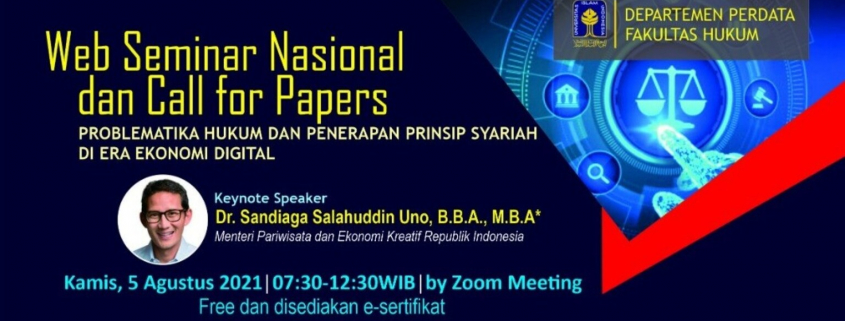
Based on the above description, the Department of Civil Law, Faculty of Law, UII will hold a webinar with the theme "Legal Problems and the Application of Sharia Principles in the Digital Economy Era."


Department of Civil Law, Faculty of Law, UII

Proudly present
NATIONAL WEB SEMINAR AND CALL FOR PAPERS
August 5, 2021, 7:30 AM – 12:30 PM
LEGAL PROBLEMS AND THE IMPLEMENTATION OF SHARIA PRINCIPLES IN THE DIGITAL ECONOMY ERA


Background

Economic Growth and Digital Investment in Indonesia from a Legal Perspective

The current momentum of economic growth and digital investment in Indonesia is valuable and must be maintained. One way to achieve this is by establishing an appropriate legal framework . This legal framework should substantively keep pace with technological developments, guarantee legal certainty and protection, and enhance Indonesia's competitiveness as a digital investment destination.

According to a 2019 report released by Temasek, Google, and Bain&Co, Indonesia's digital economy is expected to grow at a staggering 49 percent annually. The country's e-commerce sector is even predicted to exceed US$130 billion by 2025, making Indonesia one of the world's largest digital economies.

The government, business players, and academics agree that the digital economy is one of the saviors of the national economy during the COVID-19 pandemic. The digital economy has proven to continue growing amidst the sluggishness of various sectors during this pandemic.

Discussions about the digital economy involve discussing two key words: economics and technological innovation. In this regard, it's also fundamentally important to understand that technological innovation always has two sides. The positive side, which offers benefits, and the negative side, which involves various risks and potential losses. In this context, creating a legal framework that can guarantee the sustainability of innovation while providing certainty and protection, is a crucial and fundamental need.

Technological innovation is occurring in nearly every business sector, including the financial services sector. Technological innovation in the financial services sector, known as Financial Technology (Fintech), has become a unique phenomenon in this era. The Fintech era is primarily marked by the emergence of various non-financial technology companies operating in the financial services sector. Meanwhile, the banking sector continues to innovate, giving rise to what is known as digital banking.

The development of the digital economy has also introduced a variety of new transactions and financial services products that are increasingly diverse in the Islamic economy. Some examples include online buying and selling, digital wallets, cashback , and so on. These diverse transactions require a response from the Islamic economy. The digitalization of the Islamic economy can penetrate various aspects of the economy, both micro and macro. The role of digital technology in today's industry is extraordinary, with almost all economic sectors utilizing information and communication technology, or digitalization, both in product packaging and marketing. This simplifies and accelerates the distribution of information, which is used to drive faster and limitless economic growth, supported by digital technology and information technology.

From a legal perspective, the phenomenon described certainly gives rise to its own set of problems. These problems primarily relate to three things:

  1. The issue of an appropriate and adequate legal framework that is able to adapt to technological developments
  2. The issue of implementing sharia principles,
  3. Dispute resolution.


Based on the description above, the Department of Civil Law, Faculty of Law, UII will hold a webinar with the theme:

"Legal Problems and the Application of Sharia Principles in the Digital Economy Era"

Keynote Speaker : Dr. H. Sandiaga Salahuddin Uno, BBA, MBA * to be confirmed

Speakers :

  1. Prof. Dr. Paripurna Sugarda, SH, M.Hum., LL.M. (Professor of the Faculty of Law, Gadjah Mada University)
    Topic: Legal Problems in the Implementation of Banking and Financial Services in the Digital Economy Era
  2. Prof. Dr. Agus Yudha Hernoko, SH, MH (Professor of the Faculty of Law, Airlangga University)
    Topic: Contractual Aspects in Financial Technology
  3. Riyeke Ustadiyanto (CEO & Founder   iPaymu.com)
    Topic: Implementation and Legal Problems in the Implementation of Electronic Payments
  4. Prof. Dr. Basuki Rekso Wibowo, SH, MS (Professor of National University)
    Topic: Legal Problems in Civil and Business Dispute Resolution in the Digital Economy Era
  5. Bagya Agung Prabowo, SH, MH, Ph.D, (Lecturer at the Faculty of Law) Universitas Islam Indonesia)
    Topic: Implementation of Sharia Principles in the Provision of Financial Services in the Digital Economy Era

Moderator: Inda Rahadiyan, SH, MH (Lecturer at the Faculty of Law) Universitas Islam Indonesia)

Students, academics, practitioners, and the general public can participate in the National Web Seminar via Zoom Meeting for FREE and receive an e-certificate. Registration for the National Web Seminar can be done by clicking.
Call for Paper Terms and Conditions :

  1. The scope of the call for papers includes civil law, business law, procedural law, criminal law, environmental law, international law, government administrative law, and constitutional law.
  2. Participants in the call for papers can register via the link s.id/WebinarPerdataFHUII no later than August 1, 2021.
  3. The call for papers manuscript contains a title, identity, abstract, introduction, problem formulation, research method, research results and discussion, conclusion, and bibliography. Detailed writing guidelines will be sent by the committee to participants via email after registration.
  4. Manuscript presentations will be held on August 5, 2021, from 1:00 PM onwards via Zoom meeting. Presenters will receive an e-certificate.
  5. Selected manuscripts will be published in the National Proceedings with ISBN in November 2021.

try to show an example of a letter of agreement

Financial Administration Division Quality Assurance Document

 
1. Unit Quality Targets (SMU) Financial Administration Division
2. Quality Record List (DCM) Financial Administration Division
3. Work program Financial Administration Division