Lately, the mass media coverage has been dotted with news of the capture of regional heads and members of parliament in the capture operation (OTT) initiated by the Corruption Eradication Commission (KPK). Some of them were involved in cases of bribery, gratification, and extortion.
A large number of public officials who were suspected of corruption caused the empty leadership chair and the crisis of officials who were clean and with integrity. So that a comprehensive multidimensional approach is needed to prevent and limit corruption.
The topic was illustrated in the Public Discussion with the theme “Prevention of Corruption in the Political Sector” organized by the Indonesian Islamic University (UII), the Corruption Eradication Commission, and the Indonesian Institute of Sciences (LIPI), on Wednesday (19/12) at the Public Lecture Building Prof. Dr. Sardjito, UII Integrated Campus.
Vice Chancellor for Student, Religious and Alumni Affairs at UII, Dr. Drs. Rohidin, SH., M.Ag., in his speech said that we should be grateful because among the young generation who attended this event consciously still cared about the conditions of our nation’s problems.
“The younger generation is expected not to continue the corrupt culture that is already attached to the bureaucratic system in Indonesia, hopefully, the implementation of this event can encourage the birth of a young generation of Indonesians who are clean and with integrity as a cadre of future leaders,” he said.
While the Director of Education and Community Service of the Corruption Eradication Commission, Giri Suprapdiono said that the fundamental issue of high rates of corruption in Indonesia was one of the most expensive political costs, while state assistance to political parties was very low.
“The KPK recommends that the state contribute more to operational funding of political parties, along with the improvement of the code of ethics, behavior, recruitment, and care,” he said.
Furthermore, the P2P LIPI researcher, Dr. Sri Nuryanti, S.IP., M.A. added that there was a need to internalize the value of party integrity in efforts to uphold the democratic system in Indonesia.
“It is important to build a set of policies agreed upon by political parties as a standard of integrity that must be adhered to by all party cadres to minimize the risk of political corruption and abuse of power,” he concluded.
Also present at the event were Faculty of Social and Political Sciences UGM, Dr.rer.pol. Mada Sukmajati, MPP., And Dr. Kuskridho Ambardi, M.A., UGM Faculty of Law Lecturer, Dr. Zainal Arifin Mochtar, SH., LLM., Lecturer at the Faculty of Law UII, Dr. Suparman Marzuki, SH., M.Sc.



 The National Moot Court Team of the Law School, Universitas Islam Indonesia just won three awards at the National Round, Moot Court Competition which held by the Faculty of Law, Universitas Indonesia Jakarta. “Alhamdulillah, we won three awards at the same time: the second rank cup, the best memorial, and the best judge,” said the Vice Dean of the External Relations, Dr. Muntoha. The Vice Dean congratulated the team on the Deans Meeting Room, First Floor accompanied by the Secretary of the Department of Law, Bagya Agung Prabowo, Ph.D.
 Saturday night, December 22, 2018,tsunami waves hit the Sunda Strait. Our best prayers are for all our brothers in Pandeglang, Serang, South Lampung, and surrounding areas affected by this natural disaster. Let’s keep on raising concerns and joint efforts to be able to help them.



 Thousands of students from all around the world apply for higher educational studies in Hungary each year. The number of Stipendium Hungaricum applicants is continuously increasing as well as the number of available scholarship places. In the 2018/2019 round of applications, more than 4100 scholarships were awarded. In the academic year 2019/2020 more than 5000 students can begin their studies in Hungary in the framework of the Stipendium Hungaricum Programme.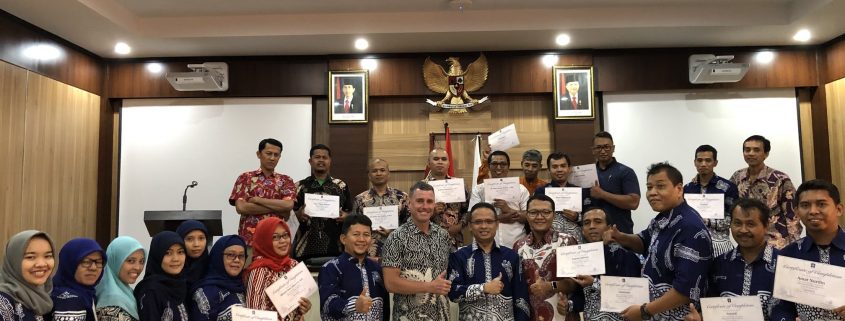
 The participants, regardless of their previous English language training or skill level, acted fearlessly to increase their abilities. They faced a wide range of activities, including written exercises in technical grammar, role plays to increase their fluency, and presentations to their peers; demonstrating a great deal of confidence. This confidence was constantly tested and on display as the participants stepped up and tacked each task. Even more impressive, they demonstrated consistent progress despite getting almost no instruction in the Indonesian language. It was a true English immersion course with a native English speaker and the students embraced the challenge. Their confidence and commitment will pay off as essential contributions to the upcoming accreditation of the UII Faculty of Law.